Search Is No Longer One Thing
Until 2022, "digital search" meant one thing: Google's blue-link results page. Optimize your website for that page, and you captured search traffic. Simple, if not always easy.
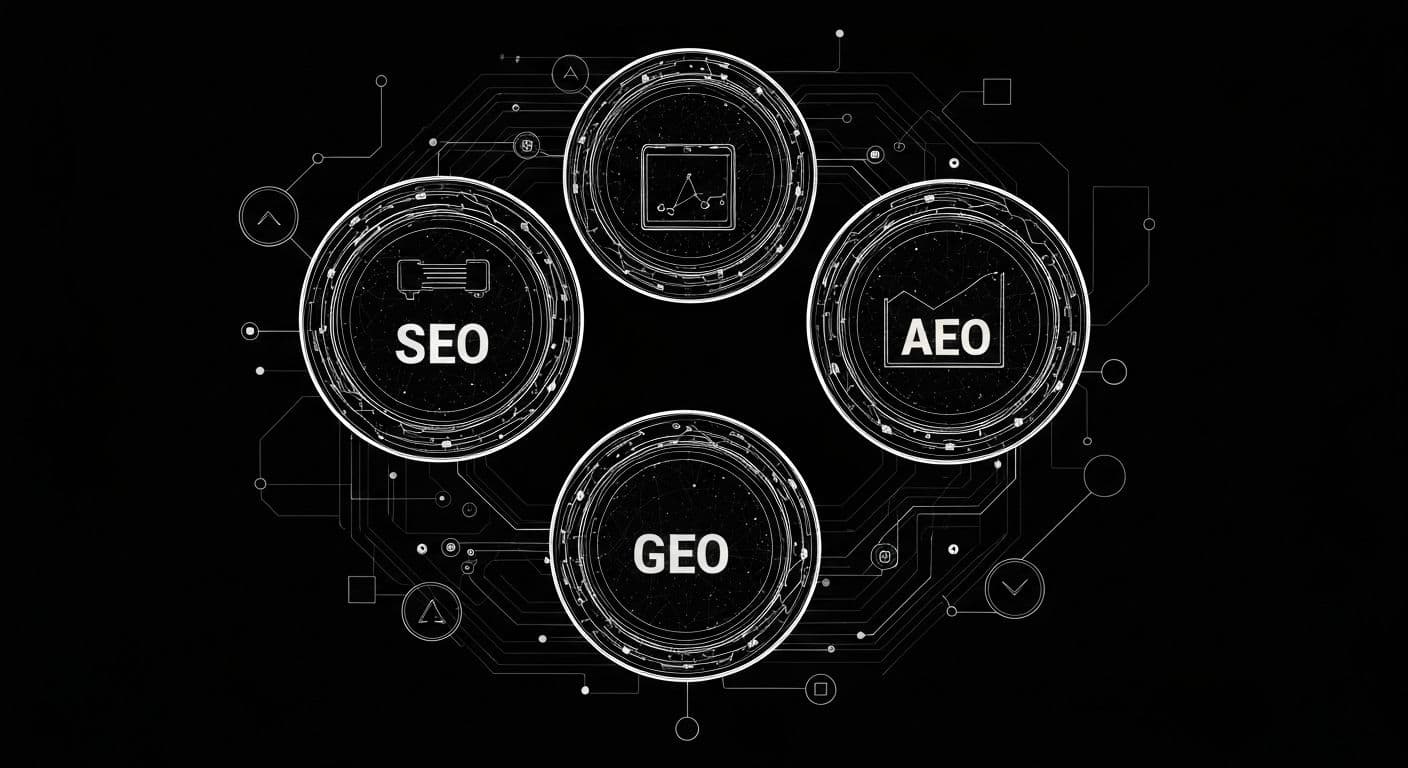
That model is gone. In 2026, your potential customer might find you (or not find you) through three completely different discovery channels, each with its own rules:
- Traditional Search (SEO): Blue links, Google Maps, Google Shopping.
- Answer Engines (AEO): Featured snippets, voice assistants, knowledge panels, Siri, Alexa.
- Generative AI (GEO): ChatGPT, Google AI Overviews, Gemini, Perplexity, Claude.
A business optimized for only one of these channels is invisible to customers using the other two.
SEO: The Foundation
Traditional Search Engine Optimization remains essential. It's the baseline from which AEO and GEO build. The core of SEO in 2026:
- Technical foundation: fast loading, mobile-first, clean crawlability
- Keyword-targeted content: pages that match what real users search for
- Domain authority: earning links and mentions from credible sources
- Local SEO: Google Business Profile, local citations, maps presence
SEO is a slow, compounding investment — results typically take 3–12 months to manifest. For Jordan and MENA markets, local SEO in Arabic is particularly underserved relative to the opportunity.
AEO: Optimizing for Voice and Featured Snippets
Answer Engine Optimization targets the zero-click search experience: voice queries, featured snippets (the box at the top of Google results), and AI assistants that answer questions without requiring a user to click a link.
AEO best practices:
- Structure content around specific questions: "What is...?", "How do I...?", "Why does...?"
- Write direct, 40–60 word answers that can be extracted as a snippet
- Add FAQ schema markup to question-based content
- Ensure conversational Arabic and formal Arabic versions of key questions
In Jordan, voice search usage is growing rapidly — particularly among younger demographics using Arabic voice queries on mobile. This makes AEO increasingly relevant for businesses targeting under-35 consumers.
GEO: Optimizing for Generative AI
Generative Engine Optimization is the newest of the three, and arguably the most disruptive. When a user asks ChatGPT or Google AI Overviews a question, the AI synthesizes an answer from multiple web sources — and the businesses cited in that synthesis get the visibility, while those not cited get nothing.
GEO requires:
- Answer-first page structure (the clearest sentence wins the citation)
- Comprehensive structured data (Organization, Service, FAQ, HowTo schemas)
- Static HTML content (key facts in the raw HTML, not just via JavaScript)
- E-E-A-T signals: author credentials, publication dates, cited sources
- Cross-web consistency: name, address, services matching everywhere
Building a Strategy That Covers All Three
The good news: well-executed content naturally performs across all three channels. A page that:
- Opens with a direct answer to the main question
- Supports that answer with detailed, factual content
- Includes FAQ schema and Organization schema
- Loads quickly and renders key content in static HTML
- Links to and from related content on the same site
...will rank in traditional search, appear in featured snippets, AND be cited by AI systems. The optimization work is the same; the frame is just wider.
At Dfeelings, we integrate SEO, AEO, and GEO into a single content strategy for our clients — so every new page or updated service description strengthens all three channels at once.